

Investing During Wars: Why History Tells Us Not to Panic
When geopolitical conflicts dominate the headlines, investors understandably become anxious. War, terrorism, and global tensions can create uncertainty in financial markets and lead many investors to ask the same question: Should I get out of the market until things calm down?
History provides a clear answer: panic selling during geopolitical events has rarely been a winning strategy.
Stock Market Performance During Geopolitical Events
Geopolitical events can cause short-term volatility, but the stock market has historically been remarkably resilient. Research examining conflicts since World War II shows that while markets sometimes decline immediately following a military event, the longer-term results have often been positive.
Data shows stocks generated positive performance one year after an act of aggression in approximately 73% of armed conflicts since World War II.
Many of the most frightening events in modern history initially rattled markets, yet in most cases markets recovered and moved higher over time. Examples include Pearl Harbor, the Cuban Missile Crisis, the Gulf War, the September 11 attacks, and Russia’s invasion of Ukraine.
Financial markets tend to react rapidly to new information.
Once uncertainty begins to clear, prices often rebound. Even during conflicts, businesses continue operating, innovation continues, and economies grow over time.
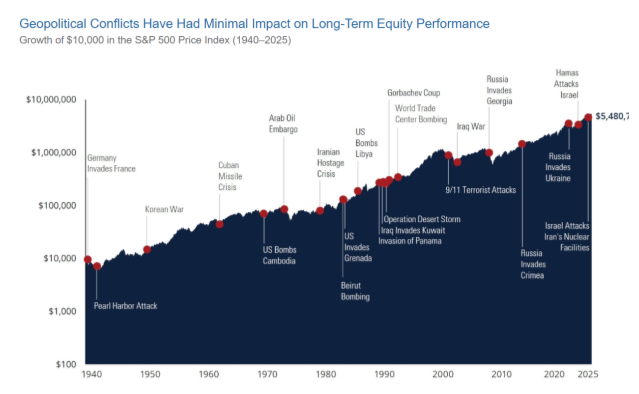
Past performance does not guarantee future results. Indices are unmanaged and not available for direct investment. Data shown does not include the reinvestment of dividend payments. Data Sources: Morningstar, Ned Davis Research, and Hartford Funds, 3/26.
Maintaining a Long-Term Perspective
At our firm, portfolios are built with a long-term strategy designed to navigate many types of market environments — including wars, recessions, and global shocks. That means maintaining diversified portfolios, staying disciplined during volatility, and avoiding emotional investment decisions.
Temporary uncertainty is inevitable, but history shows that staying invested has consistently been the more successful strategy for long-term investors.
Staying the Course in Uncertain Times
Wars and geopolitical conflicts can understandably cause concern. However, decades of market history demonstrate that these events have typically had limited long-term impact on diversified investors.
Rather than reacting emotionally to headlines, successful investors tend to focus on what they can control: their strategy, discipline, and long-term perspective. If you’d like to talk through recent events and what they could mean for your financial plan, FSG is here to help.